Join the Parade!!
Join the Parade! Virginia SAR Invited to March in the 2026 George Washington Birthday Parade
Saturday, February 14, 2026 – Old Town Alexandria, Virginia
Calendar Event Link: Virginia SAR Calendar – George Washington Birthday Parade
Saturday, February 14, 2026 – Old Town Alexandria, Virginia
Calendar Event Link: Virginia SAR Calendar – George Washington Birthday Parade
Philadelphia, Pa. – October 13, 2025—The National Parade honoring the birth of the United States Navy on October 13, 1775 and birth of the United States Marine Corps November 10, 1775 was held in Philadelphia, Pa., on October 13. Philadelphia was the location where both the Navy and Marine Corps were founded. Sgt Maj John Champe Chapter participated in the parade with a float towed by owner and Chapter member Warner Workman. Chapter President Barry Schwoerer rode the float wearing his Navy dress blue uniform and Chapter Vice President Mark Sink rode the float wearing his Marine Corps dress blue uniform. Virginia SAR Color Guard Commander Brett Osborn dressed in Navy Slops, and two Compatriots from the Pennsylvania SAR also rode the float. The float was decorated with graphics depicting Revolutionary War Navy and Marine Corps founders and leaders, Revolutionary War battles and famous ships of the early Navy. The SMJC Float was the only SAR float, and most visible SAR participant in the parade.
The first photograph is of the right side of the float.
WILLIAMSBURG, VA, (May 27, 2025) — On 3 May 2025, the Williamsburg Chapter of the Virginia Society Sons of the American Revolution and the Colonial Williamsburg Foundation conducted a ceremony to commemorate the 250th Anniversary of Virginia’s first military response to the Royal Governor’s taking of gunpowder stored in Williamsburg’s powder magazine. Governor John Murray, Earl of Dunmore falsely claimed it was for Virginia’s protection. During the night of 20–21 April 1775, British Marines landed at Burwell’s Landing on the James River and marched to Williamsburg, Virginia’s colonial capitol. They had been ordered by Governor Dunmore to remove the gunpowder stored in Williamsburg’s powder magazine. The Marines were spotted and an alarm raised. As a result, they returned to their ships without completely emptying the magazine.
Public discontent increased throughout the colony fomenting unrest, with militia companies mustering to force return of the gunpowder. Patrick Henry learned of the event and issued a call to arms. On 2 May 1775, 160 mounted militiamen from Hanover County under Henry’s command began their ride to Williamsburg to either recover the powder or be paid for it. On 3 May, they stopped at Doncastle’s Ordinary near Toano in James City County. It was here Carter Braxton convinced Henry to halt his march. Braxton, the son-in-law of Virginia’s Receiver General, Richard Corbin rode into Williamsburg to negotiate the settlement of the incident. He returned to Henry with a payment of 330 pounds to pay for the gunpowder that was taken from the armory. The Hanover militia returned to their homes and Henry journeyed to Philadelphia to participate in the Second Continental Congress. Dunmore feared for his safety and on 8 June, he and his family left in the middle of the night to take up residence aboard the British ship HMS Fowey. This incident led to the Virginia Colony’s government being taken over by a Committee of Safety and Patrick Henry becoming the independent state’s first governor in July 1776.
ALDI, Va.—On April 19, the Sgt. Maj. John Champe Chapter SAR sponsored the commemoration of the 250th Anniversary of the opening battle of the Revolution at Lexington & Concord. The commemoration took place at Champe Farms near the village of Aldi in Loudoun County. Champe Farms, once home to the chapter’s namesake, John Champe, is the site of a memorial obelisk honoring Champe’s role as a spy for General George Washington.
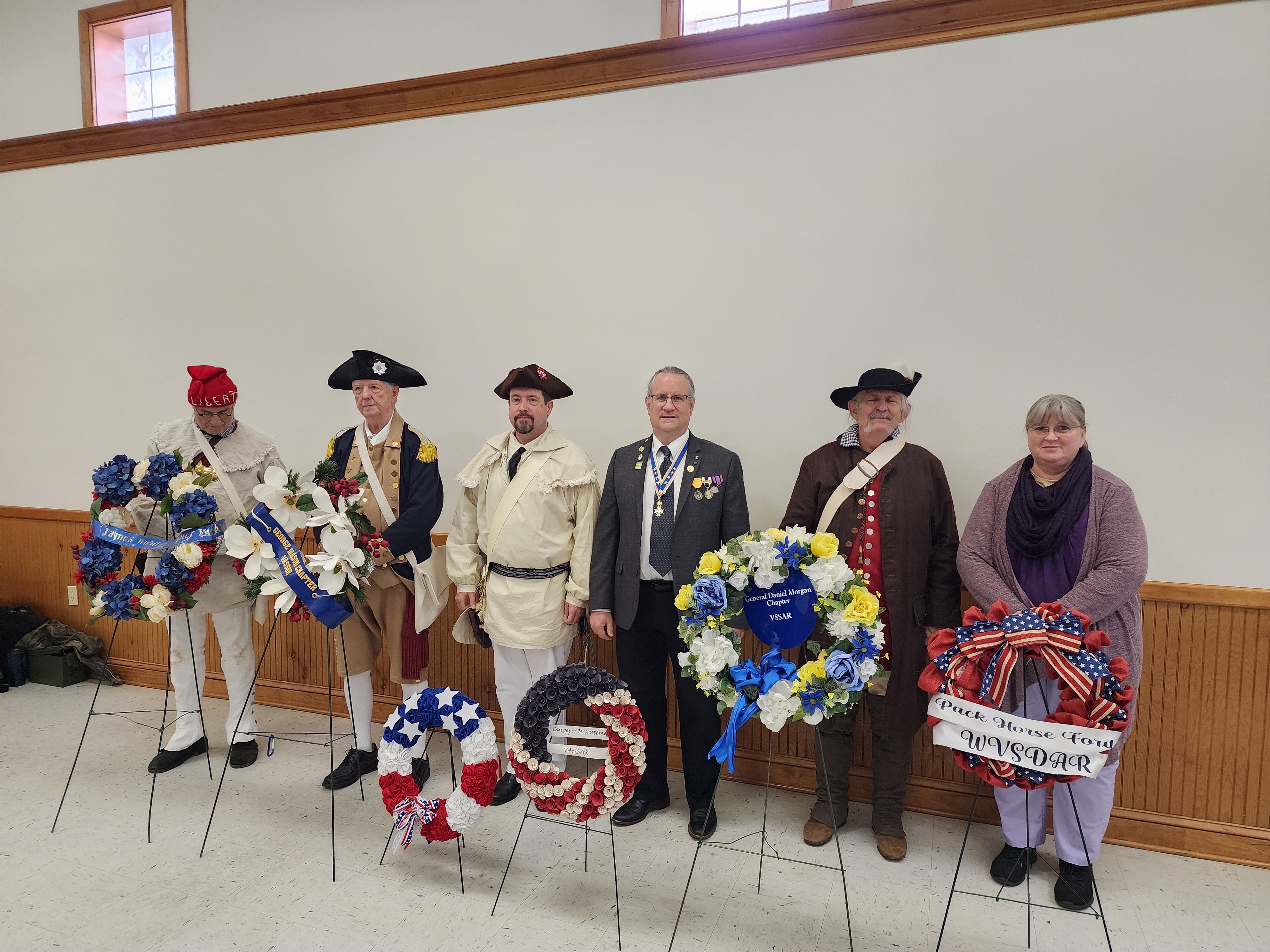
The event included a brief commemoration of John Champe before transitioning to the remembrance of Lexington and Concord. Five SAR chapters—Sgt. Maj. John Champe, Col. James Wood II, George Mason, Col. Fielding Lewis, and Col. William Grayson—joined four DAR chapters—Elizabeth McIntosh Hammill, Ketoctin, Lanes Mill and Mary Hemings Bell—in the commemoration.
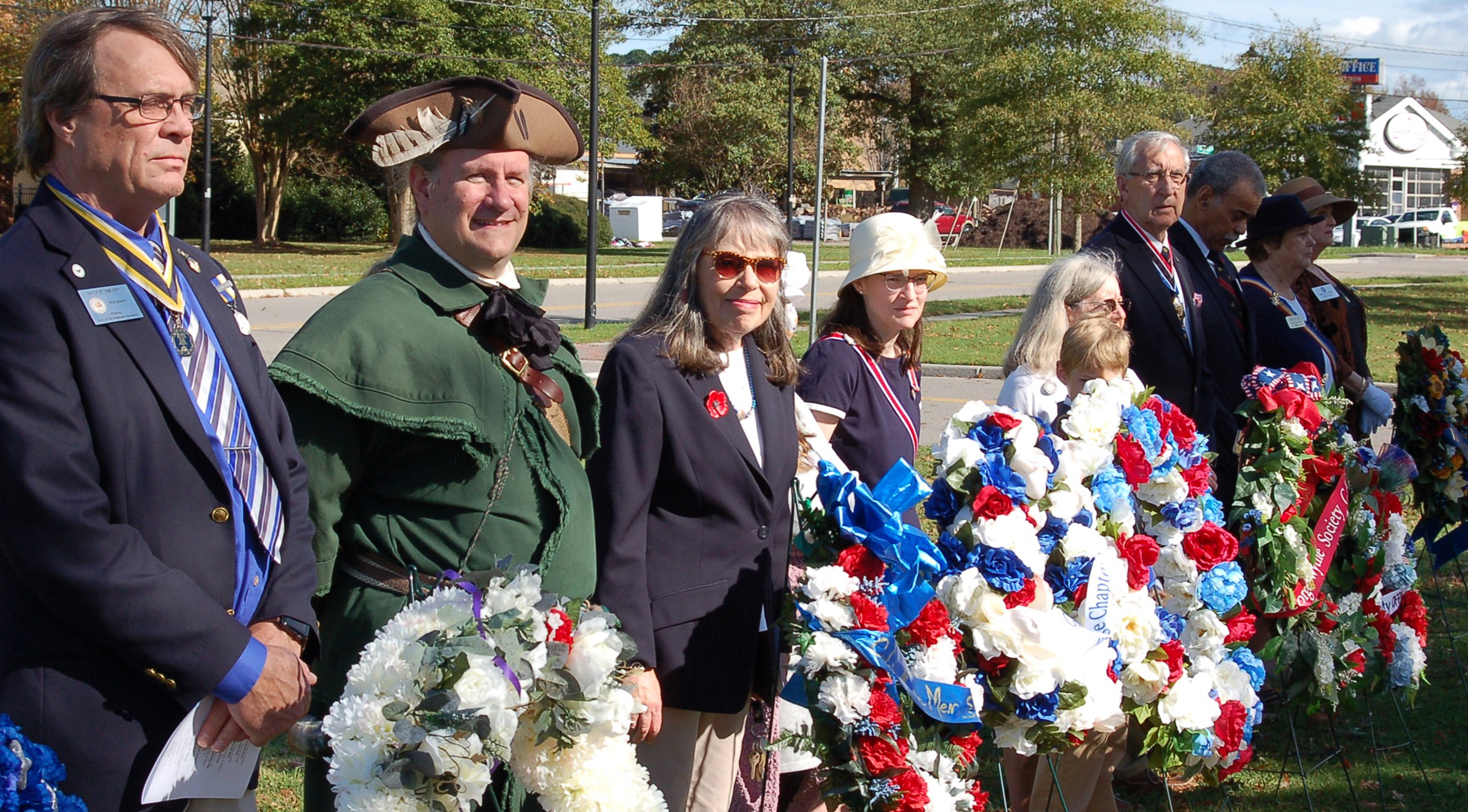
It may not be unusual for a SAR event to draw 150 attendees; however, it is unique when more than half of the attendees are French. Such was the case at the 241 Anniversary of the Battle of the Virginia Capes Commemoration held on Saturday, September 3, 2022 aboard Joint Expeditionary Base Little Creek - Fort Story in Virginia Beach. The event hosted by the Norfolk Chapter honored the French naval forces under command of Admiral Francois Joseph Paul, Comte de Grasse, that defeated the British Royal Navy.
The base, located on Cape Henry, the first landing site of Virginia’s 1607 settlers, hosts a small National Park honoring both the first landing of the Jamestown settlers on Virginia soil and Admiral de Grasse’s victory.
The Night Before Blue Licks: The Kentucky Society SAR will host a social time, dinner, and Revolutionary War program in honor of the Battle of Blue Licks. Reservations are required and can be made directly through the link on the bottom of this page. Contact Patrick Wesolosky if you have any questions about this event, [email protected].
After the Bingo, some Compatriots will have a Bluegrass Music jam session. Guests are welcome to join in. Contact Steve McCain for more details. [email protected]
photo is the color guard presenting the colors, l. to r. Michael Wilson, Richard Tyler, Paul Christensen and Jim Cordes (photo courtesy of Stacey Bassett.)
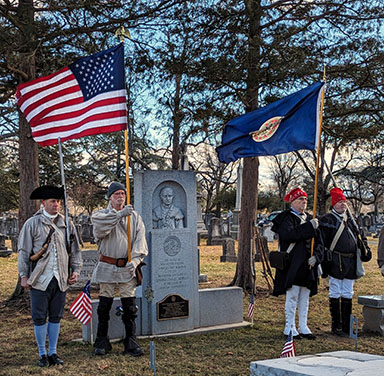
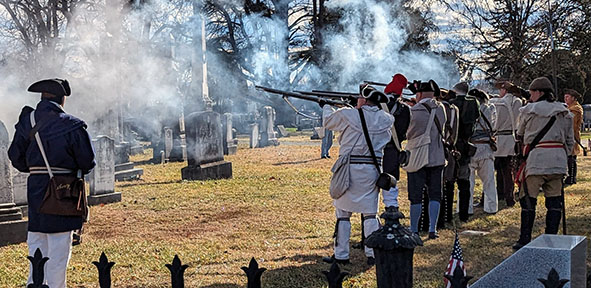
On 14 January 2023, the Colonel James Wood II Chapter of the Virginia Society Sons of the American Revolution conducted a ceremony to commemorate the Battle of Cowpens. The event was held at Mt Hebron Cemetery, near the grave site of Daniel Morgan. Morgan was the commander of the American forces and won this decisive action against one of the elite units in the British Army. This battle was the turning point in the southern campaign of the War for Independence. It was fought on 17 January 1781 near the town of Cowpens, South Carolina. General Nathanael Green was the commander of the American Army in the south. He split his army, sending Morgan to southwest to cut supply lines and hamper British operations in the back country. General Lord Cornwallis, British commander sent Lieutenant Colonel Banastre Tarleton to find and defeat Morgan. Tarleton was highly regarded by Cornwallis, but feared and hated by the Americans. It was his army at the Battle of Waxhaws where American soldiers attempting to surrender were given no quarter. This became known as Bufords Massacre and infuriated the colonists. Morgan's Army was joined by militia units, increasing his force to about 2,000 men. Tarleton led an army of 1,150 men, chasing Morgan through harsh weather conditions and rough terrain. Morgan chose the spot for the battle and deployed his troop in three lines in an open pasture known as cowpens. The land was between two low hills with the Broad River at his back. Tarleton was an aggressive leader who pushed his men hard on an exhausting march to catch the Americans. Morgan developed a plan of double envelopment which led to a devastating defeat for the British. With superior tactics, he crushed an elite British army which eventually led to the Siege of Yorktown and the American victory in the War of Independence. Morgan's army had 72 casualties and the British suffered over 300 casualties with over 500 men captured.
On 17 September 2022, the Colonel James Wood II Chapter of the Virginia Society Sons of the American Revolution conducted a ceremony to honor the memory of Daniel Morgan on Constitution Day
27 August 2022 Soldiers & Sailors Memorial Building, Huntington Village, Brooklyn, NY